


















































Quick answer: Measure your room's length times width to get square feet, then match it to a BTU size. On MRCOOL's ratings, that works out to about 1 sq ft for every 24 BTU, so a 12,000 BTU mini split covers about 500 sq ft. Ratings vary by brand, so check the product page, and round up if you're between sizes.
Mini split sizing at a glance
- BTU: British Thermal Unit, a measure of heating and cooling capacity. A bigger number means more capacity.
- Rule of thumb: about 24 BTU per sq ft on MRCOOL's ratings. Other brands rate their units differently.
- Total capacity: on a multi-zone system, the outdoor unit's BTU is shared across all the indoor heads.
- Round up: if your room falls between two sizes, choose the larger one.
This guide covers the sizing chart, an interactive tool drawn to scale, the adjustments that change the answer, and how sizing works when one outdoor unit serves several rooms. When you know your size, you can browse all mini splits or jump straight to a BTU collection.
Try the interactive mini split sizing tool
Mini Split BTU Sizing Guide
Drawn to scale — 1 square = 2 × 2 ft| Mini split size | Cools/heats up to | Typical room |
|---|---|---|
| 6,000 BTU (6K) | 250 sq ft | Small bedroom, office |
| 9,000 BTU (9K) | 375 sq ft | Bedroom, home office |
| 12,000 BTU (12K) | 500 sq ft | Large bedroom, den |
| 18,000 BTU (18K) | 750 sq ft | Living room, master suite |
| 24,000 BTU (24K) | 1,000 sq ft | Open living area |
| 36,000 BTU (36K) | 1,500 sq ft | Great room, small home |
Mini split sizing chart (MRCOOL ratings)
| Size | Up to (sq ft) | Typical room | Shop |
|---|---|---|---|
| 6,000 BTU | 250 | Small bedroom, office | Shop 6,000 BTU mini splits |
| 9,000 BTU | 375 | Bedroom, home office | Shop 9,000 BTU mini splits |
| 12,000 BTU | 500 | Large bedroom, den | Shop 12,000 BTU mini splits |
| 18,000 BTU | 750 | Living room, master suite | Shop 18,000 BTU mini splits |
| 24,000 BTU | 1,000 | Open living area | Shop 24,000 BTU mini splits |
| 36,000 BTU | 1,500 | Great room, small home | Shop 36,000 BTU mini splits |
Source: MRCOOL ratings from our product sizing data. Ratings vary by brand. Between sizes? Round up. Need more than 36,000 BTU? See our 48,000 BTU mini splits (Pioneer rates its 48K at about 1,800 sq ft) and 55,000 BTU mini splits for whole-home and multi-zone systems.
How to size a mini split in 3 steps
To size a mini split, multiply the room's length by its width to get square feet, find that number in the chart, then adjust for your home and round up if you land between two sizes.
Step 1: Measure the room (length × width = sq ft)
Measure the floor of the space you want to heat and cool, in feet. Multiply the length by the width. A room that is 20 ft by 25 ft is 20 × 25 = 500 sq ft. ENERGY STAR suggests converting inches to fractions of a foot before you multiply, so 12 ft 6 in becomes 12.5 ft. For an L-shaped or odd-shaped room, split the floor into rectangles, work out each one, and add them together (ENERGY STAR).
Measure only the area the unit will actually serve. If a doorway is usually closed, the room on the other side doesn't count. If a living room opens straight into a kitchen and dining area with no walls between them, measure the whole open space.
Step 2: Match the square footage to the chart
Find the first size in the chart whose rating covers your number. Using our worked example, 500 sq ft matches a 12,000 BTU unit on MRCOOL's ratings, which cover up to 500 sq ft. A 400 sq ft bedroom is above MRCOOL's 9,000 BTU rating of 375 sq ft, so it moves up to 12,000 BTU.
Remember that the chart above uses MRCOOL's numbers. If you're shopping another brand, use that brand's rating (see "Why ratings differ by brand" below) or the BTU guide on the product page.
Step 3: Adjust for your home, then round up if you're between sizes
Square footage is a starting point, not the whole answer. A sunny room, a kitchen, a high ceiling or a drafty older room can need more capacity than its floor area suggests, while a well-shaded room may need less. Check the adjustments in the next section, and if the adjusted number falls between two sizes, choose the larger one.
Adjustments: climate, ceiling height, sun, kitchens and insulation
The chart assumes an average room, so adjust up for sun, heat-producing kitchens, extra people, high ceilings, a cold climate or poor insulation, and adjust down only for a heavily shaded room.
The percentage figures below come from ENERGY STAR's sizing guidance for room air conditioners (ENERGY STAR). They are a useful sense-check for a mini split serving one room, but they were written for cooling. For heating, whole homes and cold climates, a load calculation is the reliable answer.
Climate (cold vs. hot regions)
Your climate matters most when you plan to heat with the mini split. A heat pump's heating output drops as the outdoor temperature falls, so in a cold region the question is whether the unit still delivers enough heat on your coldest days, not only whether it fits the floor area. ENERGY STAR advises homeowners in areas where winter temperatures regularly dip below freezing to talk to a contractor about a unit suited to their home and about pairing it with back-up heat. Look at each model's rated low-temperature performance on its product page, and for a cold-climate or whole-home system, get a professional load calculation.
Ceiling height above 8 ft
Sizing charts, including ENERGY STAR's, are based on an 8-foot ceiling. A taller ceiling means more air to heat and cool, so a vaulted room or a space with 10 ft ceilings may need more capacity than its floor area suggests. There's no single published percentage for this, so if you're near the top of a size's range and your ceilings are high, round up to the next size.
Sunny vs. shaded rooms
ENERGY STAR recommends increasing capacity by 10 percent for a very sunny room and reducing it by 10 percent for a heavily shaded one. For example, a very sunny room that would otherwise need 12,000 BTU would need about 13,200 BTU, which points you to the next size up.
Kitchens and rooms with many people
Cooking and people both add heat. ENERGY STAR suggests adding 4,000 BTU if the unit is used in a kitchen, and adding 600 BTU for each person beyond two who regularly uses the room. That means an open kitchen and family room usually needs a size up from what the floor area alone suggests.
Insulation, windows and air leaks
A well-insulated, well-sealed room holds its temperature, so it needs less capacity. Old single-pane windows, a lot of glass, an uninsulated garage or a room over an unheated space all lose heat faster and need more. The U.S. Department of Energy notes that as a home's efficiency improves, the right size of heating and cooling equipment goes down, so if you've recently insulated or air-sealed, factor that in too.
When to get a Manual J load calculation
For a whole home, a cold climate, or an unusual space like a converted garage, vaulted great room or sunroom, ask an HVAC professional for a Manual J load calculation. Manual J is the industry method from ACCA (the Air Conditioning Contractors of America). It works out the heating and cooling your space actually needs from its walls, windows, insulation, air leakage and orientation. ENERGY STAR says your contractor should verify system size with Manual J (ENERGY STAR), and the DOE Building America Solution Center recommends running it for each zone and for the whole house.
Single-zone vs. multi-zone: BTU is total system capacity
The BTU rating on a mini split system is the outdoor unit's total capacity. A single-zone system sends all of it to one indoor head in one space, while a multi-zone system shares it across several indoor heads in different rooms.
This is where many buyers get confused. A "24,000 BTU 2-zone system" doesn't mean each room gets 24,000 BTU. It means one outdoor unit (the condenser) with 24,000 BTU of capacity, feeding two indoor heads that share it.
Size each indoor head for its own room
On a multi-zone system, size every indoor head with the chart, using the square footage of the room it serves. Then choose an outdoor unit that the manufacturer approves for that combination of heads. For example, a 375 sq ft bedroom gets a 9,000 BTU head and a 500 sq ft living room gets a 12,000 BTU head on MRCOOL's ratings, and you'd look for an 18,000–24,000 BTU condenser listed with a 9K + 12K pairing.
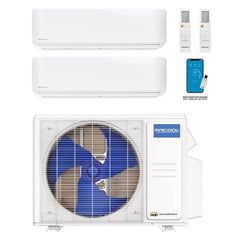
Each manufacturer sets its own rules for which heads and how many can connect to each condenser, and the combined head sizes don't always add up exactly to the condenser's rating. For example, we carry a MRCOOL DIY 2-zone 18,000 BTU system with two 12K wall-mount heads. Always pick from the combinations listed for the condenser rather than mixing heads on your own. On MRCOOL product pages, the BTU sizing tool has a condenser tab that shows how each head uses up the condenser's capacity.
The DOE Building America Solution Center also recommends sizing each zone separately and checking the total for the whole house. Its cold-climate guide adds that you shouldn't choose a multi-zone system only because of the number of rooms you have. Sometimes one well-placed head can serve two connected rooms, or two smaller single-zone systems work better than one large multi-zone (DOE guide to sizing heat pumps in cold climates).
How many zones do you need?
Count the separate spaces that need their own temperature control and that air can't easily flow between. One open space, a garage or an addition usually needs one zone. A bedroom plus a living area is often two. Heads in closed-off rooms only heat and cool those rooms, because, as ENERGY STAR notes, heat has a hard time moving through an open doorway and can't move through a closed one.
- Single-zone mini splits: one outdoor unit, one indoor head, one space.
- 2-zone mini splits: two rooms, such as a bedroom and a living room.
- 3-zone mini splits: three rooms or areas from one outdoor unit.
- 4-zone mini splits: four rooms, often a whole floor or a small home.
Between sizes? Round up
If your room falls between two sizes, round up to the larger one. A slightly larger unit runs efficiently at partial load, while an undersized one runs constantly and may never reach the temperature you set.
Most mini splits use variable-speed (inverter) compressors that can run at lower output, which is why a slightly larger unit can still run smoothly. ENERGY STAR describes this kind of variable-speed compressor as able to "vary the speed of the internal compressor motor to continuously control the temperature" (ENERGY STAR).
Rounding up one step is not the same as buying the biggest unit you can afford, though. ENERGY STAR warns that "bigger is not always better." An oversized air conditioner costs more to buy, wastes energy, and can cool a room before it removes the humidity, leaving it damp and clammy (ENERGY STAR). The U.S. Department of Energy cautions against "casual sizing estimates based on home floor area" and notes that oversizing is very common. Its cold-climate guide says grossly oversized equipment can lead to excessive cycling, low efficiency and poor summer dehumidification (DOE guide to sizing heat pumps in cold climates).
The practical rule: go up one size when you're between sizes or your room has extra heat from sun, cooking or people. Don't jump two or three sizes "just to be safe." For a whole home, let a Manual J calculation settle the question.
Why ratings differ by brand
Each manufacturer rates its own units, so the same BTU size can be listed for different room sizes depending on the brand. A 12,000 BTU unit is rated for 500 sq ft by MRCOOL and Pioneer, 550 sq ft by Daikin, and 750 sq ft by Senville.
That's why this guide doesn't give one square-footage number for every brand. The table below shows the ratings from our product sizing data. Use the column for the brand you're buying, and check the BTU guide on each product page before you order.
| Size | MRCOOL | Pioneer | Senville AURA | Senville LETO | Senville ELITE | Daikin |
|---|---|---|---|---|---|---|
| 6K | 250 | — | 250 | — | — | — (7K head: 300) |
| 9K | 375 | 350 | 450 | 450 | 450 | 400 |
| 12K | 500 | 500 | 750 | 750 | 750 | 550 |
| 15K | — | — | 800 | — | — | 700 |
| 18K | 750 | 750 | 1,000 | 1,000 | 1,000 | 850 |
| 24K | 1,000 | 1,000 | 1,350 | 1,250 | 1,500 | 1,000 |
| 30K | — | 1,200 | — | 1,500 | — | — |
| 33K | — | — | 1,750 | — | — | — |
| 36K | 1,500 | 1,400 | — | 1,800 | — | — |
| 48K | — | 1,800 | — | — | — | — |
Source: manufacturer ratings from our product sizing data. "—" means we don't carry that size in that series, or no rating is listed.
- MRCOOL mini splits: these ratings power the sizing tool above, about 24 BTU per sq ft across the range.
- Pioneer mini splits: close to MRCOOL at most sizes, and they also offer 30K and 48K ratings.
- Senville mini splits: the AURA, LETO and ELITE series have different ratings, especially at 24K, so check the series name in the product title.
- Daikin mini splits: rated between MRCOOL and Senville at most sizes. Note that 7K is a Daikin indoor head size, not a system size.
- TURBRO: available in our 48,000 BTU collection. We don't have square-footage ratings for TURBRO, so size each room with the chart and check the product specs.
When ratings differ, the higher number isn't automatically "better." For a borderline room, the lower (more conservative) rating gives you more headroom, so if your room is near the top of a range, round up.
DIY vs. professional installation
A DIY mini split is designed for a homeowner to install, while a professional-install system needs an HVAC technician to connect the refrigerant lines and start it up. Sizing works the same way for both.
DIY systems such as MRCOOL DIY mini splits ship with pre-charged line sets, so the refrigerant connections are made without the vacuum pump and gauges a technician would use. You still mount the indoor head and outdoor unit, drill a wall penetration and run electrical power. Read the manufacturer's installation manual before you buy, so you know what's involved and what tools and wiring it calls for.
Professionally installed mini splits are standard systems that need an HVAC technician to install, evacuate and charge. They come in a wider range of sizes, styles and multi-zone combinations. If you go this route, ENERGY STAR suggests choosing a well-reputed contractor familiar with ductless systems, and that contractor can also run the Manual J load calculation.
Warranty terms and installation requirements vary by manufacturer and model. Check the warranty details on each product page or in the manufacturer's documents before deciding which route is right for you.
Line sets and mounting
The line set (the copper refrigerant lines and wiring between the indoor head and the outdoor unit) has to be long enough to reach between them along the route it will actually take, so plan your mounting spots and choose the length when you order.
Before ordering, decide where the indoor head will hang and where the outdoor unit will sit. Then measure the path the lines will follow through the wall, along the exterior and around corners, not just the straight-line distance. ENERGY STAR suggests running lines through closets, attics, basements, crawlspaces or an attached garage where possible, to avoid patching walls. Each system lists its included line length and the maximum it supports in its specs, so check that your route fits before choosing.
- Mini split line sets for professionally installed systems and extensions.
- DIY line sets, pre-charged to match DIY systems.
- Mounting kits: wall brackets, ground pads and stands for the outdoor unit.
For the outdoor unit, ENERGY STAR recommends a spot with unobstructed airflow, away from doors and windows (units drip water when they defrost in winter) and out of roof runoff.
How much does a mini split cost?
Mini split equipment from our store starts at $669.99 for a single-zone 9,000 BTU system, and the price rises with capacity, efficiency and number of zones. These prices are for equipment only and don't include installation.
| Size collection | From | Lowest-priced system in the collection |
|---|---|---|
| 9,000 BTU | $669.99 | Senville LETO 9K, 110V |
| 12,000 BTU | $738 | Pioneer Diamante Essenza 11,500 BTU, 230V |
| 18,000 BTU | $969.99 | Senville LETO 18K |
| 24,000 BTU | $1,168 | Pioneer Diamante Essenza 23,000 BTU |
| 36,000 BTU | $1,969.99 | Senville LETO 30K (true 36K systems from $2,069.99, Senville LETO 36K) |
Prices change often, so the product page always shows the current price. What drives cost up: more BTU, more zones (each indoor head adds cost), cold-climate models, and indoor styles such as ceiling cassettes. Don't forget line sets, mounting kits and electrical supplies when you budget.
Installation cost depends on your home, your local labor rates and the system, so get a written quote from a local HVAC contractor if you're going the professional route. To price a complete system with heads, line sets and accessories, build your mini split system.
Mini split sizing FAQ
Here are short answers to the questions we hear most about mini split sizing.
What size mini split do I need?
Measure the room's length × width to get square feet, then match it to a BTU size. As a rough guide, 9,000 BTU covers about 350–450 sq ft and 12,000 BTU about 500–750 sq ft, depending on brand. Adjust for climate, sun, ceiling height and insulation, and round up if you're between sizes.
How many square feet does a 12,000 BTU mini split cool?
About 500 to 750 square feet, depending on the brand. MRCOOL and Pioneer rate their 12,000 BTU units at 500 sq ft, Daikin at 550, and Senville at 750. Sunny rooms, high ceilings and cold climates may need more capacity, so check the brand's rating on each product page.
What size mini split for 1,000 sq ft?
For one open 1,000 sq ft space, MRCOOL, Pioneer and Daikin each rate a 24,000 BTU unit at about 1,000 sq ft. Some Senville models rate 18,000 BTU at 1,000 sq ft. If the area is split into several rooms, a multi-zone system with a head sized for each room usually works better.
What size mini split for 600 sq ft?
MRCOOL and Pioneer rate 12,000 BTU at 500 sq ft, so for 600 sq ft with those brands, round up to 18,000 BTU. Daikin's 12,000 BTU is rated at 550 sq ft, so that's also a round-up. Senville rates 12,000 BTU at 750 sq ft, which covers 600. Sun and climate can change the answer, so round up when in doubt.
Is mini split BTU per room or total?
The BTU rating on a system is the outdoor unit's total capacity. A single-zone system uses it all for one space. A multi-zone system shares it across several indoor heads, and each head is sized for its own room, such as a 9,000 BTU bedroom head plus a 12,000 BTU living room head.
Do mini splits heat and cool?
Mini split heat pumps both heat and cool. They move heat indoors in winter and outdoors in summer. Most systems we sell are heat pumps. Check the product title or specs for "heat pump" to confirm, and check its rated low-temperature performance if you live in a cold climate.
How we sourced these numbers
Room-size ratings come from each manufacturer's published ratings, stored in our product sizing data. Adjustment figures come from ENERGY STAR's sizing guidance, and our advice on load calculations and oversizing follows ENERGY STAR and the U.S. Department of Energy. Prices are from our store on the date shown and change often.
Shop mini splits by BTU
Found your size? Shop by BTU, or build a complete system with heads, line sets and accessories.
Comments
0 comments