





















































Updated October 2026
If your home needs a new heating and cooling system, the biggest decision you’ll face is choosing between a mini split vs central air setup—and picking the wrong one can cost you thousands more than it should.
At a glance, both systems do the same job: they heat and cool your home. But how they do it, what they cost, and where they make the most sense are completely different. That’s where most homeowners get stuck. Do you go with a traditional ducted system or a ductless option? Is the lower upfront cost really the better deal long-term? Can you install it yourself, or are you locked into hiring a pro? And what do SEER2 ratings and 2026 refrigerant changes actually mean for your purchase?
This guide breaks it all down in a clear, side-by-side comparison so you can confidently choose the right system for your home. We’ll cover real-world costs, efficiency differences, installation requirements, ideal use cases, and the latest 2026 updates like new SEER2 minimums and the shift away from R-410A refrigerant. By the end, you’ll know exactly which system fits your space, your budget, and your goals.
And when you’re ready to buy, Home Outlet Direct makes it easy to move forward. You’ll find a wide selection of both ductless mini splits and central HVAC systems, competitive pricing that helps you stay on budget, fast shipping, and real support if you need help choosing.
Shop All HVAC Systems at Home Outlet Direct →
Mini Split vs. Central Air — Quick Answer
When comparing mini split vs central air, both are excellent options. The right choice comes down to your home’s setup, your budget, and how you want your system to perform day to day.
-
Central air is best for whole-home comfort, especially if you already have ductwork and want one system that handles everything.
-
Mini splits are ideal for homes without ducts, room additions, flexible zoning, DIY-friendly installs, and higher efficiency potential.
Here’s a quick side-by-side breakdown to help you see the difference fast:
|
Factor |
Mini Split (Ductless) |
Central Air (Ducted) |
|
Ductwork Required |
No |
Yes |
|
Upfront Equipment Cost |
Lower for one or a few rooms; rises with each zone |
Rises with tonnage; new ductwork extra if needed |
|
Energy Efficiency (SEER2) |
Often 18–22+ |
Typically 14–18 |
|
Installation Complexity |
DIY possible (MRCOOL) |
Licensed HVAC required |
|
Whole-Home Coverage |
Zone by zone |
Entire home, one system |
|
Aesthetics |
Wall-mounted unit visible |
Vents only — hidden system |
|
Best For |
No-duct homes, additions, zoning |
Homes with existing ductwork |
|
Lifespan |
15–20 years |
15–20 years |
If you already have ductwork and want a simple, all-in-one solution, central air usually makes the most sense. If you’re working without ducts or want room-by-room control and efficiency, a mini split system often comes out ahead.
Let’s break down exactly how each system works, and where each one really shines.
What Is a Mini Split System?
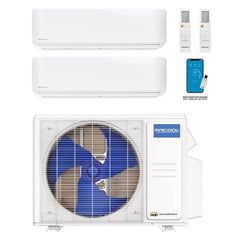
A mini split system is a ductless heating and cooling solution that gives you direct control over individual rooms or zones in your home.
Instead of relying on ductwork, a mini split uses an outdoor condenser connected to one or more indoor air handlers through a small wall penetration. Refrigerant flows directly between the units, which means you avoid the energy losses that often come with traditional ducted systems.
The indoor and outdoor units are joined by a line set: insulated copper refrigerant lines plus a control cable that run through that wall opening. The indoor air handler is mostly a fan and a coil. It pulls in room air, heats or cools it over the coil, and blows it back into the room.
Mini splits come in two main configurations:
-
Single-zone systems for heating and cooling one room or space
-
Multi-zone systems that can handle up to 5 or more rooms from a single outdoor unit
Each indoor unit and the area it serves is called a zone. You set the temperature for each zone on its own, so you don’t have to heat or cool rooms nobody is using.
Most mini splits are heat pumps, so they don’t just cool your home in the summer. They also provide efficient heating in the winter by reversing the refrigeration cycle.
One of the biggest advantages, especially for DIYers, is installation flexibility. Brands like MRCOOL offer homeowner-friendly systems with pre-charged No-Vac line sets. That means no vacuum pump, no specialized tools, and no HVAC certification required for installation in many cases.
If you’re looking for a flexible, energy-efficient option without the hassle of ductwork, mini splits are often the go-to choice.
Shop Ductless Mini-Split Systems at Home Outlet Direct →
What Is a Central Air System?
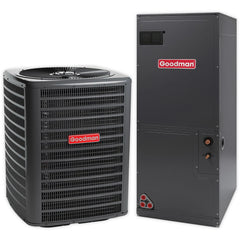
A central air system is a traditional ducted HVAC setup designed to heat and cool your entire home through a single, unified system.
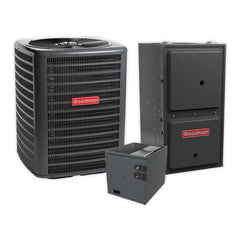
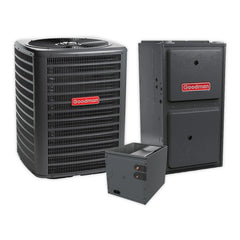
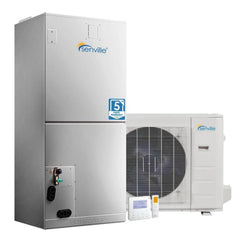
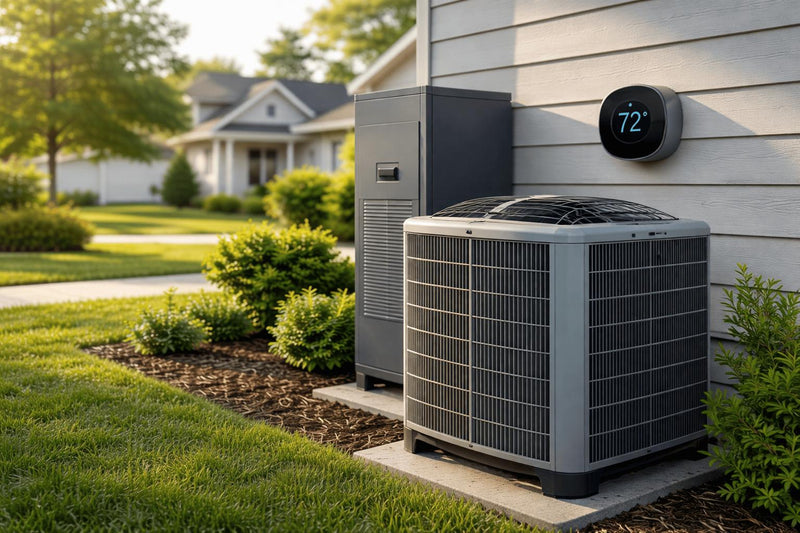
It typically includes an outdoor condenser/compressor paired with an indoor air handler or a furnace with an evaporator coil. Conditioned air is pushed through a network of ducts and delivered into each room through supply vents, then cycled back through return vents.
Central systems are usually set up in one of two ways:
-
AC + furnace combo, where the air conditioner handles cooling and a gas furnace provides heat
-
Central heat pump, which can both heat and cool using a single system
One of the biggest considerations here is ductwork. Central air requires existing ducts in good condition, or a full duct installation if your home doesn’t have them. That can significantly increase the total project cost in older homes or new additions.
From a user standpoint, central air is simple. One system controls the temperature across your entire home, making it easy to manage. The trade-off is less flexibility compared to ductless systems, since you can’t easily adjust temperatures room by room without adding zoning controls.
If your home already has ductwork and you want a clean, hidden system that delivers consistent comfort throughout, central air is often the most straightforward choice.
Browse Central Ducted HVAC Systems at Home Outlet Direct →
Mini Split vs. Central Air: Cost Comparison
When comparing mini split vs central air, cost is often the deciding factor, but it’s not just about the equipment. Installation, ductwork, and labor can swing the total price by thousands depending on your home.
Let’s break it down so you can see where your money actually goes.
Equipment Cost
Here’s how equipment cost compares by system type. Prices change often, so check current pricing on each product page. Keep in mind, central systems almost always require professional installation, while some mini splits (like MRCOOL DIY) can be installed yourself.
|
System Type |
Relative Equipment Cost |
What You Get |
|
Mini Split (Single-Zone) |
Lowest of these options |
1 outdoor + 1 indoor unit; covers 1 room/zone |
|
Mini Split (Multi-Zone, 2–3 zones) |
Moderate; rises with each indoor unit |
1 outdoor + 2–3 indoor units; covers multiple rooms |
|
Mini Split (Multi-Zone, 4–5 zones) |
Higher; one indoor unit per room |
Whole-home ductless coverage; high efficiency |
|
Central Split System (2–3 ton) |
Moderate |
Covers 1,000–2,000 sq ft; standard efficiency |
|
Central Split System (3–5 ton) |
Higher; rises with tonnage and efficiency |
Covers 2,000–3,500+ sq ft; larger homes |
|
Packaged Unit |
Moderate to higher, depending on size |
All-in-one outdoor unit; requires existing ducts |
Total Installed Cost (Including Labor)
This is where the real difference shows up. Installation complexity, and especially ductwork, can dramatically change your total investment.
|
System Type |
How the Total Compares |
Notes |
|
Mini Split (Single-Zone, DIY MRCOOL) |
Lowest: equipment plus supplies and electrical work |
Homeowner installs; minimal to no labor cost |
|
Mini Split (Single-Zone, Pro Install) |
Equipment plus HVAC labor |
HVAC technician installs; labor varies by region and job |
|
Mini Split (Multi-Zone, Pro Install) |
Higher; labor grows with each zone |
Cost increases with number of zones and installation complexity |
|
Central Air (Replacement, Existing Ducts) |
Equipment plus labor; existing ducts reused |
More affordable when ductwork is already in place |
|
Central Air (New Construction or Duct Retrofit) |
Highest; new ductwork adds major cost |
New ductwork adds significant labor and material cost |
If your home doesn’t already have ductwork, a mini split system is usually the more cost-effective route. Installing new ducts can quickly double the total cost of a central air system, while ductless systems avoid that expense entirely.
If you’re trying to stay within a tighter budget, or you want more control over installation costs, mini splits, especially DIY-friendly options, often give you a much clearer path forward.
Energy Efficiency — SEER2 Ratings Compared
When weighing mini split vs central air, energy efficiency is where mini splits often pull ahead, especially under the newer 2026 standards.
SEER2 (Seasonal Energy Efficiency Ratio 2) measures how efficiently a system cools your home over an entire season. The higher the number, the less energy the system uses to deliver the same level of comfort.
SEER2 replaced the older SEER rating in 2023 with stricter, more real-world testing conditions. And as of 2026, all newly manufactured systems must also use low-GWP refrigerants like R-32 or R-454B, replacing older R-410A. These updates make efficiency ratings more accurate and push manufacturers toward cleaner, more energy-conscious systems.
Why Mini Splits Are Typically More Efficient
Mini splits tend to outperform central air systems for one simple reason: there’s no ductwork.
In a central HVAC system, conditioned air travels through ducts before reaching your rooms, and those ducts can lose 20–30% of energy through leaks, poor insulation, or long runs. Mini splits avoid this entirely by delivering air directly into each zone.
That’s why:
-
Mini splits commonly reach 18–25+ SEER2
-
Central air systems typically fall between 14–18 SEER2, with premium variable-speed models reaching up to 21
In hotter climates or homes with high cooling demand, that efficiency gap can translate into real savings. In many cases, a high-SEER2 mini split can offset its higher upfront cost within 3–7 years through lower utility bills.
SEER2 Rating Breakdown
|
SEER2 Range |
Efficiency Level |
Typical System |
Best For |
|
14–15 SEER2 |
Standard (2026 minimum) |
Entry-level central air |
Budget buyers, mild climates |
|
16–18 SEER2 |
Mid-Efficiency |
Mid-range central or mini split |
Most homeowners — best value |
|
19–22 SEER2 |
High-Efficiency |
Premium central or standard mini split |
Hot climates, lower bills |
|
23+ SEER2 |
Ultra-High / Premium |
High-end mini splits (MRCOOL 5th Gen) |
Maximum savings, energy-focused |
If lowering your monthly energy bills is a top priority, mini splits usually offer the strongest long-term advantage. But if your home already has efficient ductwork and you choose a higher-end central system, you can still achieve solid performance without a major jump in upfront cost.
Now let’s take a look at installation, and why that alone can completely change which system makes the most sense for your home.
Installation: Which Is Easier (and Cheaper) to Install?
When deciding between mini split vs central air, installation is often the turning point. It affects not just cost, but timeline, disruption, and whether you can realistically handle any of the work yourself.
Central Air Installation
Central air systems always require a licensed HVAC technician. There’s no real DIY path here due to refrigerant handling, electrical connections, and duct integration, which can be dangerous if not properly handled.
If your home already has ductwork in good condition, installation is fairly straightforward. A technician will replace the outdoor condenser and indoor unit, reconnect everything, and get the system running.
But if your home doesn’t have ducts, things change quickly.
Installing new ductwork adds significant cost to the project. It also means cutting into walls, ceilings, or floors to run duct lines throughout the home. That adds time, labor, and disruption.
Typical timelines:
-
1–2 days for a standard system replacement with existing ducts
-
3–5 days (or more) for new duct installation or major modifications
For many homeowners, especially in older homes or additions, this is where central air becomes significantly more expensive and invasive.
Mini Split Installation
Mini splits offer much more flexibility, especially when it comes to installation.
Traditional systems still require an HVAC technician, since refrigerant lines need to be vacuumed and properly charged. But even then, installation is usually simpler and less invasive than central air.
You can browse both types: MRCOOL DIY mini splits ship with pre-charged line sets, while professional mini splits are vacuumed and charged on site by an HVAC technician.
Then there’s the game-changer: MRCOOL DIY systems.
With MRCOOL’s DIY series, the system comes with pre-charged No-Vac line sets. That means:
-
No vacuum pump
-
No refrigerant handling
-
No HVAC certification required in many cases
A typical single-zone MRCOOL DIY install can be completed in 4–8 hours by a handy homeowner. You’re essentially mounting the indoor unit, connecting the pre-charged lines, and wiring the system—without the specialized steps that usually require a pro.
Even multi-zone mini splits, while more complex, are still far less disruptive than installing ductwork throughout a home.
And instead of tearing into walls and ceilings, installation usually involves just a small 3-inch hole through an exterior wall to connect the indoor and outdoor units.
If you’re looking for the simplest, fastest, and often most affordable path to installation, mini splits—especially DIY-friendly systems—have a clear advantage.
Shop MRCOOL DIY Mini Splits at Home Outlet Direct →
Pros and Cons: Mini Split vs. Central Air
When comparing mini split vs central air, this is where the differences really stand out. Each system has clear strengths and a few trade-offs depending on your home and priorities.
Mini Split Pros and Cons
Mini Split Pros
-
No ductwork required, ideal for older homes and additions
-
Higher SEER2 efficiency means lower monthly energy bills
-
DIY installation possible with MRCOOL DIY series
-
Zone-by-zone control, can heat/cool only occupied rooms
-
Quiet operation, especially inverter and variable-speed models
-
Doubles as a heat pump, one system heats and cools
Mini Split Cons
-
Indoor wall units are visible, and some buyers dislike the look
-
Multi-zone systems require separate indoor unit in each room
-
Higher equipment cost for multi-zone whole-home coverage
-
Requires a dedicated electrical circuit per outdoor unit (most need 208/230V; some 9,000 and 12,000 BTU models run on 115V)
-
Less familiar to some HVAC technicians for service or repair
Central Air Pros and Cons
Central Air Pros
-
Whole-home comfort from a single, hidden system
-
Familiar technology widely serviced by HVAC contractors
-
Lower equipment cost for large whole-home coverage
-
Vents are hidden, so no visible indoor units
-
Strong resale value, as this system is expected by many home buyers
-
Gas furnace pairing handles extreme cold more reliably
Central Air Cons
-
Requires existing ductwork in good condition
-
Duct energy losses reduce real-world efficiency (20–30%)
-
New ductwork adds significant installation cost
-
No room-by-room temperature control without add-ons
-
Requires licensed HVAC tech for all installation and service
-
Ductwork can harbor dust, allergens, and mold over time
When to Choose a Mini Split vs. Central Air: Use Case Guide
This is where the mini split vs central air decision becomes clear. Your home’s layout, your goals, and how you plan to use the system will usually point you strongly in one direction or the other.
Choose a Mini Split If…
-
Your home does not have existing ductwork (older homes, converted spaces, detached garages, ADUs)
-
You’re adding a room, finishing a basement, or building an addition your current system can’t handle
-
You want room-by-room temperature control, especially in multi-story homes or households with different comfort preferences
-
You want a DIY installation option to save on labor, with MRCOOL DIY as the standout choice
-
You care more about energy efficiency and lower monthly bills than having a completely hidden system
-
You need to heat or cool a specific zone without replacing your entire HVAC system
Choose Central Air If…
-
Your home already has ductwork in good condition, making it the most cost-effective replacement option
-
You want one unified system with a single thermostat and no visible indoor units
-
You live in a colder climate and plan to pair your system with a gas furnace for reliable heating
-
Resale value matters, since central HVAC is expected by many buyers and real estate agents
-
Your home is larger (2,500+ sq ft) and you want consistent whole-home coverage from one system
If you’re still deciding, it often comes down to this: homes without ducts or with specific comfort needs lean toward mini splits, while homes with existing ductwork and a need for simple, whole-home control tend to favor central air.
Shop All HVAC Systems at Home Outlet Direct →
Sizing Guide: How Much BTU Do You Need?
Choosing the right size system is just as important as choosing between mini split vs central air. If your system is too big or too small, you’ll end up with comfort issues, higher energy bills, and unnecessary wear on your equipment.
Understanding BTUs and Tonnage
BTU (British Thermal Unit) measures how much heating or cooling power a system produces. In HVAC terms:
-
12,000 BTU = 1 ton of cooling capacity
Getting this right matters:
-
Oversized systems short-cycle (turn on and off frequently), which leads to poor humidity control, higher energy use, and more wear on components
-
Undersized systems run constantly, struggle to maintain temperature, and still leave you uncomfortable
A general rule of thumb is about 20 BTU per square foot, but that can vary depending on your climate, insulation, ceiling height, and sun exposure.
BTU Sizing Chart
|
Zone / Home Size |
BTU Needed |
Tonnage |
Best System |
|
Up to 400 sq ft |
9,000 BTU |
0.75 ton |
Single-zone mini split |
|
400–1,000 sq ft |
12,000–18,000 BTU |
1–1.5 ton |
Single or dual-zone mini split |
|
1,000–1,500 sq ft |
18,000–24,000 BTU |
1.5–2 ton |
Multi-zone mini split or small central |
|
1,500–2,000 sq ft |
24,000–30,000 BTU |
2–2.5 ton |
Central split or multi-zone mini split |
|
2,000–2,500 sq ft |
30,000–36,000 BTU |
2.5–3 ton |
Central split system |
|
2,500–3,500 sq ft |
36,000–48,000 BTU |
3–4 ton |
Central split or packaged unit |
|
3,500+ sq ft |
48,000–60,000+ BTU |
4–5+ ton |
Central split; dual-system for large homes |
If you’re cooling a single room or defined space, a mini split makes sizing straightforward—you match the BTU to that zone. For whole-home systems, especially central air, sizing becomes more critical and often benefits from a professional load calculation.
For room-by-room mini split sizing with each brand’s own ratings, use our mini split sizing guide and calculator.
Getting your sizing right upfront helps ensure your system runs efficiently, keeps you comfortable, and lasts as long as it should.
MRCOOL: DIY Mini Splits Built for Homeowners
If you’re leaning toward ductless in the mini split vs central air decision, MRCOOL is the brand that makes that choice a whole lot easier.
MRCOOL has built its reputation around one thing: making high-performance mini split systems accessible to homeowners. Their DIY-friendly designs remove the biggest barrier to entry (installation) while still delivering the efficiency and reliability you’d expect from a professional-grade system.
Why MRCOOL Stands Out
-
True DIY installation: MRCOOL’s pre-charged No-Vac line sets mean you don’t need a vacuum pump, gauges, or HVAC certification. You can install it yourself and skip thousands in labor costs.
-
5th Gen DIY Series: This is their flagship line, designed for modern homeowners and can do a lot.
-
App-based smartphone control
-
15–22 SEER2 efficiency depending on model
-
Hyper-heat performance down to -13°F, meaning no separate furnace is needed in most climates
-
Advantage Series (Pro Install): If you prefer a traditional install, MRCOOL also offers contractor-grade systems with strong efficiency and competitive pricing.
-
Scalable for Any Home: From single-room solutions to full multi-zone systems (up to 5 zones), MRCOOL gives you flexibility whether you’re upgrading one space or your entire home.
Why Buy MRCOOL from Home Outlet Direct?
When you shop MRCOOL systems at Home Outlet Direct, you’re not just getting a great product—you’re getting real value:
-
Competitive pricing that helps you stay within budget
-
Fast shipping so your project doesn’t stall
-
Warranty support and customer service you can rely on
-
Current MRCOOL systems that use R-454B refrigerant (check the refrigerant listed on each product page)
If you want the efficiency, flexibility, and cost savings of a mini split—without the complexity—MRCOOL is hard to beat.
Shop All MRCOOL Systems at Home Outlet Direct →
2026 Updates: What’s Changed for HVAC Buyers
If you’re comparing mini split vs central air in 2026, there are a few important updates that directly impact what you should buy:
-
SEER2 is now the standard: All systems must meet updated SEER2 efficiency requirements. Make sure any unit you’re considering is rated in SEER2, not the older SEER metric.
-
New refrigerants are here: R-410A is being phased out. New 2026-compliant systems use low-GWP refrigerants like R-32 or R-454B (Puron Advance), which are more environmentally friendly and future-proof.
-
The federal tax credit has ended: The federal Energy Efficient Home Improvement Credit (25C) covered qualifying systems placed in service by the end of 2025. It does not apply to systems installed in 2026, so check state and utility rebates instead.
-
Heat pumps work in colder climates: Modern systems, especially inverter-driven mini splits, can now operate efficiently down to -13°F. For many homeowners, that means you can skip a separate gas furnace entirely.
When you shop through Home Outlet Direct, check the SEER2 rating and the refrigerant type on the product page before you buy. Current split systems use R-454B or R-32. For more on the change, see our R-454B vs. R-410A guide.
Why Buy Your HVAC System from Home Outlet Direct?
Once you’ve narrowed down your mini split vs central air decision, where you buy your system matters just as much as what you buy.
Home Outlet Direct is built for homeowners who want real value without the usual headaches.
-
Wide selection in one place: Shop central split systems, ductless mini splits, packaged units, and even geothermal heat pumps without bouncing between retailers
-
Top brands at competitive prices: Find trusted names like MRCOOL, Goodman, and more, often priced below MSRP so you can get more for your budget
-
Fast, direct-to-door shipping: No big-box delays or middleman markups. Your system ships straight to you so you can start your project sooner
-
Real support when you need it: Get expert guidance before and after your purchase through live chat or by calling 800-495-0144
-
Current-generation systems: Shop SEER2-rated systems that use R-454B or R-32 refrigerant, built for today’s regulations
If you want a smooth buying experience with strong pricing and real support behind it, Home Outlet Direct makes it easy to move forward with confidence.
Browse All HVAC Systems at Home Outlet Direct →
Final Checklist Before You Buy
Before you lock in your mini split vs central air decision, run through this quick checklist to make sure everything lines up. A few minutes here can save you time, money, and frustration later.
-
System type decided: mini split, central air, or a hybrid approach
-
Ductwork situation confirmed: existing ducts in good condition or no-duct home
-
Correct BTU and tonnage sized for your space and climate
-
SEER2 rating selected based on your efficiency and energy savings goals
-
2026 refrigerant compliance confirmed (R-32 or R-454B, not R-410A)
-
Electrical requirements verified, including a 240V dedicated circuit if needed
-
Installation plan chosen: DIY with MRCOOL or licensed HVAC contractor
-
Budget finalized, including both equipment and total installed cost
-
State and utility rebate eligibility checked (the federal 25C tax credit ended after 2025)
Once you’ve checked all the boxes, you’re ready to buy with confidence and move forward with the right system for your home.
Shop HVAC Systems Now at Home Outlet Direct →
FAQs — Mini Split vs. Central Air
Is a mini split cheaper than central air?
For homes without existing ductwork, yes—a mini split is almost always cheaper in total installed cost. Single-zone systems have a low starting equipment cost, and MRCOOL DIY models can save on installation labor. In contrast, central air with new duct installation is usually the most expensive route.
Does a mini split heat as well as a central air system?
Yes. Modern mini splits are heat pumps that both heat and cool, and many models operate efficiently down to -13°F. In most climates, they can fully replace both an AC and a furnace, though in extreme cold, a central system paired with a gas furnace may still perform better.
Do mini splits work for whole-home cooling?
Yes—a multi-zone mini split system can handle an entire home without ductwork. Each room gets its own indoor unit with individual temperature control. For larger homes over 2,500 sq ft, multiple outdoor units or a central system may be more practical depending on layout.
Can I install a mini split myself?
Yes, if you choose a MRCOOL DIY system. These come with pre-charged No-Vac line sets that don’t require a vacuum pump or HVAC certification. Traditional mini splits and all central air systems still require professional installation.
What SEER2 rating should I look for in 2026?
At minimum, a new system must meet the federal standards set in 2023: 13.4 SEER2 for central AC in northern states, 14.3 SEER2 for most central AC in southern states, and 14.3 SEER2 with 7.5 HSPF2 for split-system heat pumps nationwide. For better efficiency and long-term value, most homeowners should target 16–18 SEER2. If you want maximum energy savings, especially in hot climates, 19+ SEER2 systems can reduce utility costs significantly over time.
What refrigerant do new HVAC systems use in 2026?
All new systems use low-GWP refrigerants like R-32 or R-454B, replacing older R-410A. Before you buy, check the refrigerant listed in the product title or specs.
Are mini splits good for older homes?
Yes, they’re often the best option. Mini splits don’t require ductwork, making them ideal for older homes where installing ducts would be expensive or impractical. Installation is minimally invasive and typically only requires a small wall opening.
Find Your Perfect HVAC System at Home Outlet Direct →


Comments
0 comments