




















































Updated October 2026
Goodman, Trane and Carrier all build dependable, code-compliant central air conditioners, so the best choice depends on what you value most. Goodman is the value-focused option, backed by parent company Daikin and built around R-32 refrigerant. Trane adds 12-year registered compressor coverage on select higher-tier models, and Carrier's top Infinity line focuses on humidity control, quiet variable-speed operation and connected controls.
Across all three, a correctly sized, properly installed system matters more than the logo on the cabinet. Below we compare the three using figures published by the manufacturers and the EPA. (Full disclosure: we sell Goodman central systems, not Trane or Carrier.)
The Short Answer: What Each Brand Is Best For
- Goodman suits homeowners who want an efficient, Daikin-backed system with value positioning. Its current systems use R-32, and you can buy the equipment online and hire your own licensed installer.
- Trane suits long-term owners who value extended compressor coverage on select models and a registered warranty that can transfer to the next owner.
- Carrier suits homeowners who prioritize humidity control, quiet operation and smart, zoned controls on its top Infinity systems.
Goodman vs. Trane vs. Carrier at a Glance
| Goodman | Trane | Carrier | |
|---|---|---|---|
| Parent company | Daikin (since 2012) | Trane Technologies | Carrier |
| Central AC efficiency (per the manufacturer) | Entry models near the federal minimum, up to 19 SEER2 (GXV9S) | 13.4 up to 23.6 SEER2 | Up to 21 SEER2 (Infinity 21) |
| Refrigerant in current systems | R-32 | R-454B on most residential products; some R-32 | R-454B, marketed as Puron Advance |
| Standard parts warranty | 5 years; 10 if registered within 60 days | 5 years; 10 if registered within 60 days | 5 years; 10 if registered within 90 days |
| Extra coverage on select models | 10-year unit replacement on two-stage and inverter models (registered owners) | 12-year compressor when registered | Optional 5-year parts plus 3-year labor via participating dealers |
| How it's sold | HVAC contractors, plus online retailers like us | Trane dealers | Carrier dealers |
| Best for | Value and buying flexibility | Long-term ownership | Humidity control and connected comfort |
Warranty terms vary by model, so check the certificate for the exact unit you're quoted.
Price: Where the Cost Differences Come From
Prices change often, and installed cost depends heavily on your home and your contractor, so check current pricing on each product page. What helps more is knowing what drives the difference between quotes:
- Compressor tier: In every brand, equipment cost climbs from single-stage to two-stage to variable-speed.
- System scope: Tonnage matters, and so does whether you replace only the outdoor unit and coil or the air handler or furnace too.
- Your home: Duct condition, electrical work, permits and local labor rates can move a quote more than the brand does.
The biggest structural difference between these three is how each brand is sold.
Goodman
Goodman is usually sold through local HVAC contractors, but it's also available online through retailers like Home Outlet Direct. You can see equipment pricing up front, buy the system you want, then hire a licensed local installer. One rule to know: Goodman offers no warranty on equipment bought online unless a dealer installs it to all applicable codes and licensing requirements, so plan on a licensed HVAC contractor.
Trane
Trane residential systems are typically sold and installed by Trane dealers, so equipment and installation usually come in one quote. Trane's limited warranty excludes products bought on an uninstalled basis, including online.
Carrier
Carrier's lineup runs from the single-stage Comfort series through the Performance series to the Infinity line, sold and installed through Carrier dealers. Its warranty for R-454B condensing units excludes products purchased over the internet.
When you compare quotes, compare like for like: the same tonnage, the same compressor type, and a matched indoor and outdoor system with its AHRI efficiency rating.
Efficiency and SEER2 Ratings
SEER2 measures how much cooling a system delivers per unit of electricity over a season; higher means lower cooling costs. Federal minimums for split central air conditioners are 13.4 SEER2 in the North and 14.3 SEER2 in the South and Southwest, and split heat pumps need 14.3 SEER2 nationwide. All three brands sell entry models at or near those minimums. (New to the ratings? See what a SEER rating is and how SEER2 differs.)
At the top end, each manufacturer lists:
- Goodman: up to 19 SEER2 on the inverter-driven GXV9S air conditioner and 21 SEER2 on the GZV9S heat pump. The Goodman systems on our site range from 13.4 to 19 SEER2.
- Trane: air conditioners from 13.4 up to 23.6 SEER2, the top rating on its variable-speed model.
- Carrier: up to 21 SEER2 on the variable-speed Infinity 21.
The practical takeaway: the biggest efficiency jumps come from moving up a compressor tier, not from switching brands within the same tier. Ratings also depend on the matched indoor coil or air handler, so check the AHRI rating for the exact combination you're buying.

Reliability and Durability
All three are long-established manufacturers, and for any of them, installation and maintenance have an outsized effect on performance. ENERGY STAR notes that improper installation can reduce system efficiency by up to 30 percent and may shorten equipment life.
- Trane backs select higher-tier outdoor units with a 12-year registered compressor warranty, two years beyond its standard registered parts term.
- Carrier emphasizes quiet, steady operation on its variable-speed Infinity line and lists the Infinity 21 as running as low as 55 decibels.
- Goodman has built central air conditioners and heat pumps since 1982 and joined Daikin in 2012. Its equipment is assembled at the Daikin Texas Technology Park in Waller, Texas, just outside Houston.
For a closer look at Goodman on its own, see our guide Is Goodman a Good Brand?
Warranty Coverage
Standard terms are similar across the three: 5 years on parts, extended to 10 when you register on time. What differs is the registration window, the extras on select models, and what happens when you sell your home.
- Goodman: 5-year parts limited warranty, or 10 years when you register online within 60 days of installation. Goodman's two-stage and inverter models, such as the GLXT7C and GXV9S, add a 10-year unit replacement limited warranty for registered owners. Residents of California, Florida, Georgia and Quebec get registered-owner coverage without registering. See Goodman's warranty guide.
- Trane: Base coverage is typically 5 years on parts, rising to 10 when you register within 60 days. Select higher-tier outdoor units get a 12-year registered compressor term. Labor isn't included. A registered warranty can transfer to the next owner if the transfer is completed within 90 days of closing and the transfer fee is paid. See Trane's warranty page.
- Carrier: Register within 90 days and choose either a 10-year parts-only limited warranty or 5-year parts plus 3-year labor. The labor option requires an installing dealer who participates in Carrier's Consumer Choice program. Miss the window and the standard 5-year parts warranty applies, and subsequent owners generally get 5-year coverage. See Carrier's warranty page.
Whichever brand you choose, register on time and keep your installation paperwork. Standard parts warranties generally exclude labor, so ask your installer what labor warranty they offer.
Refrigerant and the 2025–2026 Transition (R-32 vs. R-454B)
This is where the brands visibly diverge. Under the EPA's Technology Transitions rule, part of its AIM Act program, new residential and light commercial AC and heat pump systems must use a refrigerant with a global warming potential (GWP) below 700, starting January 1, 2025. EPA has since added flexibility for older inventory: according to its restrictions by sector (updated August 2026), residential systems built entirely from components made or imported before 2025 have no installation deadline. Manufacturers' current residential lines, including all three brands here, have moved to lower-GWP refrigerants. R-410A, the long-time standard, has a GWP of 2,088 on EPA's reference table.
- Goodman uses R-32 (GWP 675) in its newer air conditioners and heat pumps. R-32 is a single-component refrigerant, which Daikin says makes it easy to recover, recycle and reclaim. It isn't new to the Daikin family: Daikin says it was the first to introduce air conditioning and heat pump technology using R-32, in Japan in November 2012.
- Trane says most of its residential products have used R-454B since January 1, 2025, and some use R-32.
- Carrier uses R-454B, which it markets as Puron Advance. (You may also see Opteon XL41, Chemours' trade name for R-454B.) Carrier notes that R-454B runs at pressures similar to R-410A but isn't a drop-in replacement.
R-454B is a blend of R-32 and R-1234yf with a lower GWP, about 465 on EPA's table, while R-32 is a single pure compound. For a homeowner, neither is clearly "better." Both are below EPA's 700 GWP limit, both carry an A2L (lower flammability) safety classification, and EPA's SNAP program accepts both for new residential AC and heat pumps subject to use conditions. Neither is interchangeable with R-410A or with each other; a system must run on the refrigerant on its nameplate.
If you have an R-410A system, EPA says you can keep maintaining and repairing it. Replacing both the outdoor unit and the indoor coil counts as a new system, though, so a full replacement today usually means R-32 or R-454B equipment. See our R-454B vs. R-410A guide for more.

Who Owns Who: Parent Companies and Sister Brands
Each of these brands sits inside a larger HVAC company with sister brands:
- Goodman has been part of Japan's Daikin Industries since 2012; Goodman describes Daikin as a worldwide leader in residential and commercial HVAC. Daikin also sells Daikin-branded equipment (we carry Daikin mini splits), and Amana-brand heating and air conditioning is manufactured under license by Daikin.
- Trane is part of Trane Technologies, whose other heating and cooling brands include American Standard and Ameristar. Trane and American Standard outdoor units even share one limited warranty document.
- Carrier's heating and cooling brands include Bryant, Day & Night, Heil, Tempstar, Comfortmaker, Arcoaire and Keeprite. The former Payne brand is now WeatherMaker by Carrier.
What this means for you: a value-positioned brand isn't automatically a lesser product, so compare matched-system ratings, warranty terms and installer quality rather than the badge alone.
Installation Quality Matters More Than Brand
A correctly sized, correctly installed system from any of these brands will typically outperform a mis-sized or poorly installed one from another. ENERGY STAR also notes that sealing and insulating ducts can improve heating and cooling efficiency by as much as 20 percent. Whoever you hire, look for:
- A room-by-room load calculation, not "same size as the old one"
- A matched indoor and outdoor system with an AHRI rating
- Refrigerant charge set to the manufacturer's specifications
- Sealed ductwork and verified airflow
- Permits and inspections where your area requires them
Brand still matters, since warranty terms, parts availability and refrigerant choice are real differences. But if you're choosing between a premium brand installed poorly and a value brand installed well, choose the good installation. Our HVAC buying guide covers sizing and system types in more detail.
Our Verdict: Which Brand Should You Choose?
Choose Goodman if…
- You want a value-focused system from a Daikin-owned manufacturer
- You want R-32 equipment
- You'd like to see equipment pricing up front, buy online and hire your own licensed installer
- You'd rather put your budget toward correct sizing and a quality installation
Choose Trane if…
- You plan to stay long-term and value 12-year compressor coverage on select models
- You might sell and want a registered warranty that can transfer to the next owner
- You prefer one dealer handling both equipment and installation
Choose Carrier if…
- Humidity control and quiet, steady operation are priorities
- You want connected controls and zoning (Carrier lists up to eight zones on the Infinity 21)
- You'd like the option of manufacturer-backed labor coverage through a participating dealer
Where to Buy Goodman Central AC Systems
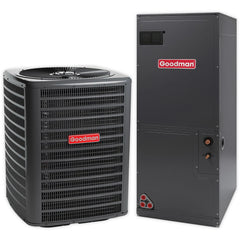
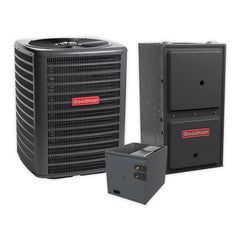
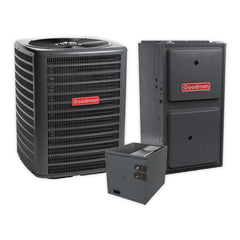
If Goodman fits your budget and priorities, shop Goodman central split systems on our site, including air conditioner and gas furnace systems and heat pump split systems. Not sure which you need? Our heat pump vs. AC guide can help, and our Goodman brand page answers common questions about the brand.
We ship free to the contiguous 48 states. HVAC equipment ships by freight with curbside delivery and a scheduled delivery appointment (see our shipping policy), and financing is available at checkout. Line up a licensed HVAC contractor for installation to keep Goodman's warranty in force.


Comparing beyond Goodman? Browse all central A/C systems we carry, or shop all HVAC.
FAQs
Is Goodman as reliable as Trane or Carrier?
Goodman has built central air conditioners and heat pumps since 1982 and has been part of Daikin since 2012, with equipment assembled at the Daikin Texas Technology Park near Houston. For any of these brands, correct sizing, a quality installation and regular maintenance have the biggest influence on long-term performance.
What's the difference between R-32 and R-454B?
Both are lower-GWP, A2L-classified refrigerants that replaced R-410A in new residential systems. R-32, used by Goodman, is a single-component refrigerant with a GWP of 675. R-454B, used by Carrier and most Trane residential products, is a blend of R-32 and R-1234yf with a GWP of about 465. They're two strategies for meeting the same EPA rule, and neither is a drop-in replacement for R-410A.
Does a lower-priced Goodman system mean lower-quality parts?
Not necessarily. Price reflects features, positioning and how a brand is sold: Goodman is also available online, while Trane and Carrier are typically sold through their dealers. Compare matched-system SEER2 ratings and warranty terms model by model rather than judging by price alone.
How long do central air conditioners last?
Both Trane and Carrier estimate about 15 to 20 years for a properly maintained central air conditioner, and Carrier stresses that this is an estimate, not a guarantee. Climate, usage, installation quality and maintenance affect lifespan more than brand choice.
Do I need a professional installer for any of these brands?
Yes, for all three. Installing a split system involves refrigerant handling, line sets and electrical work, and Trane's and Carrier's warranties require installation by a licensed HVAC professional. Goodman is more flexible on the purchasing side because you can buy it online, but it offers no warranty on internet purchases unless a dealer installs the equipment to all applicable codes and licensing requirements.

Comments
0 comments