























































Updated October 2026
The best refrigerator for your kitchen comes down to two choices: the configuration (how the doors and freezer are arranged) and the installation style (how it fits your cabinets). For most households, a French door refrigerator is the most versatile pick. Side-by-side models suit narrow kitchens, top- and bottom-freezer models suit tighter budgets and secondary spaces, and built-in, panel-ready or column refrigeration suits custom kitchens.
Those two decisions are easy to blur together, so this guide takes them one at a time:
- What configuration do you want? French door, side-by-side, top or bottom freezer, or column.
- How do you want it to install? Freestanding, counter-depth, built-in or panel-ready.
Once you've answered both, we'll walk you through sizing, features, specialty refrigeration, budget and the brands we carry.
What to Consider Before You Buy a Refrigerator
Before comparing models, take stock of four things:
- Kitchen layout and space. Measure the width, height and depth of your opening, plus door swing and walkway clearance. Built-in and column refrigerators also need the exact cutout and ventilation clearances listed in the installation guide.
- Household size and eating habits. Bigger households and frequent cooks need more capacity and more flexible storage than someone who eats out most nights.
- Budget, including installation. Built-in and panel-ready units typically cost more than freestanding models once cabinetry, panels and installation are factored in.
- How long you plan to stay. A built-in refrigerator is part of your kitchen design. A freestanding model is easier to replace or take with you.
Replacing several appliances at once? Start with our kitchen appliance buying guide, then come back here for the refrigerator details.
Types of Refrigerators: Configurations Compared
"Configuration" refers to how the doors and freezer are arranged. Here's how the five main configurations compare.
| Configuration | Best for | Typical capacity | Pros | Cons |
|---|---|---|---|---|
| French door | Most households | About 17–29 cu. ft. | Full-width shelves for large items; freezer on the bottom keeps fresh food at eye level | Usually costs more than top- or bottom-freezer models |
| Side-by-side | Narrow kitchens, ice and water lovers | About 15–26 cu. ft. | Narrow doors need less swing room; easy-to-reach freezer; often a through-the-door dispenser | Narrow shelves make sheet pans and platters hard to fit |
| Bottom freezer | Fridge-first convenience on a budget | About 8–21 cu. ft. | Fridge at eye level; easier to organize than a top freezer | A freezer drawer can be harder to organize than shelves |
| Top freezer | Budget shoppers, secondary fridges, small kitchens | About 10–20 cu. ft. | Typically the lowest cost; simple and energy efficient | More bending to reach the fridge; dated look |
| Column refrigerator and freezer | Custom and luxury kitchens, large families | Roughly 8–17 cu. ft. per column; combine as needed | Independent fridge and freezer columns; stainless or panel-ready fronts | Highest total cost; needs cabinetry and professional installation |
French Door Refrigerators
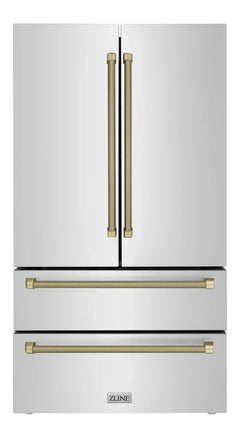
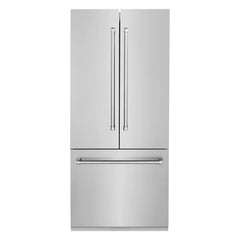
French door refrigerators are a common choice for family kitchens, and for good reason. Two narrow upper doors need less swing room than a single wide door, and the bottom freezer keeps your most-used fresh food at eye level. Most French door models also have full-width shelves, which matters for sheet pans, party platters and big casserole dishes.

Shop French Door Refrigerators
Side-by-Side Refrigerators
Side-by-side units split the fridge and freezer vertically, each behind its own full-height door. They're a smart pick for narrow kitchens where a wide door won't clear an island, and they put frozen food within easy reach without bending. The main trade-off is shelf width: pizza boxes and large trays often won't fit.

Shop Side-by-Side Refrigerators
Bottom-Freezer Refrigerators
Bottom-freezer models keep a single-door fridge section at eye level and tuck a freezer drawer below. They split the difference between the affordability of a top freezer and the ergonomics of a French door, and they're common in compact widths. In our lineup you'll find bottom-freezer models from compact 22- and 24-inch units to full-size and built-in models, including Forno's Milano and Custodia lines and built-in bottom-freezer refrigerators from ZLINE and Thor Kitchen.
Top-Freezer Refrigerators
Top-freezer refrigerators remain a practical choice for apartments, garages, basements or a secondary unit. They're simple, typically the least expensive to buy, and efficient to run: ENERGY STAR notes that models with the freezer on top tend to use the least energy compared with bottom-freezer and side-by-side models. Our current lineup centers on the other configurations, so we don't list top-freezer models at the moment.
Column Refrigerators and Freezers
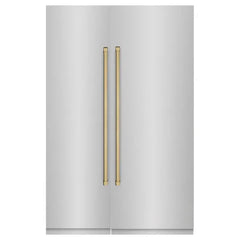
Column refrigeration separates the fridge and freezer into independent, full-height cabinets, so you choose how much of each to install: one of each, two fridge columns and a freezer, or a full wall. Columns are built-in by design, and most come with stainless steel doors or panel-ready fronts.

Some columns are convertible: each Forno Maderno column can run as a refrigerator or a freezer. Our Forno 60-inch Maderno review explains how a pair works.
Shop Column Refrigerators and Freezers
Freestanding vs. Counter-Depth vs. Built-In
Once you've picked a configuration, the second decision is installation style. Depths below are typical ranges: some brands quote the cabinet box and others include doors and handles, so always check the spec sheet and installation guide for the exact model.
| Installation style | Typical depth | Relative cost | Look | Ventilation and install |
|---|---|---|---|---|
| Freestanding (standard depth) | Roughly 30–36 in. including doors | Lowest | Sticks out past counters and cabinets | Needs the small air gaps listed in the manual; easy to place and replace |
| Counter-depth (freestanding) | Roughly 24–30 in. including doors | Moderate | Close to flush with counters | Same as freestanding, with a shallower box |
| Built-in | About 24–25 in. cabinet depth | Higher | Flush with standard 24-in.-deep base cabinets | Usually vents through a top grille or front kick plate; needs a surrounding cabinet opening |
| Panel-ready (built-in) | Same as built-in | Highest | Custom panels match your cabinet doors | Same as built-in, plus panel fabrication and fitting |
Freestanding Refrigerators
Freestanding refrigerators are finished on the sides and slide into an opening without dedicated surrounding cabinetry. They're usually the most affordable option, the easiest to replace, and standard-depth models give you the most interior space for their width. If budget and flexibility matter more than a seamless look, freestanding is the practical choice.
Shop Freestanding Refrigerators
Counter-Depth Refrigerators
Counter-depth refrigerators are shallower than standard-depth units, so the front sits close to flush with your countertops instead of jutting out. You get a more built-in look for less than a true built-in, though you'll usually give up some interior capacity.
Shop Counter-Depth Refrigerators
Built-In Refrigerators
Built-in refrigerators are designed to be enclosed by cabinetry, with ventilation routed through the front or top rather than the sides or back. They sit flush with standard base cabinets for a permanent, high-end look. The trade-off: they need a precise cabinet opening and professional installation, and they stay with the house when you move.

Panel-Ready Refrigerators
Panel-ready refrigerators are built-in units that accept custom cabinet panels instead of a factory finish, so the appliance disappears into your kitchen design. Panel-ready columns and refrigerator drawers take the idea furthest. Expect the highest total cost here, since you're paying for the appliance plus custom panels and installation. Learn more in our guide to panel-ready appliances.

Shop Panel-Ready Refrigerators
What Size Refrigerator Do You Need?
Refrigerator capacity is measured in cubic feet (fridge and freezer combined). A widely used starting rule of thumb is 4 to 6 cubic feet per household member. It isn't an industry standard, and manufacturers' own sizing advice varies, so treat it as a starting point. If you cook often, entertain or buy groceries in bulk, aim for the high end or above.
| Household size | Rule-of-thumb capacity | Configurations that commonly fit |
|---|---|---|
| 1–2 people | About 4–12 cu. ft. | Top or bottom freezer, compact 22- to 30-inch models |
| 3–4 people | About 12–24 cu. ft. | 30- to 36-inch French door, bottom freezer or side-by-side |
| 5+ people | About 20 cu. ft. and up | 36-inch standard-depth French door, wide built-in, or a column fridge and freezer pair |
If you fall between sizes, lean toward more capacity rather than less to avoid daily frustration.
Key Features to Look For
Cooling Technology and Temperature Zones
Dual cooling systems keep the fridge and freezer air separate, which helps each section hold a steady temperature and keeps freezer odors out of fresh food. Look for "dual cooling" or "dual evaporator" on the spec sheet. Convertible zones, drawers or compartments that switch between fridge and freezer temperatures, let one refrigerator adapt to entertaining, bulk shopping or seasonal needs.
Ice and Water Dispensers
Through-the-door dispensers are convenient for everyday use. Many built-in and panel-ready models use an internal water and ice dispenser instead, which keeps the door fronts clean-lined. If you entertain often, look for a model that makes both cubed and crushed ice, or add a dedicated ice maker (see below).
Smart Features and Connectivity
Some refrigerators offer Wi-Fi app control, and a few include interior cameras so you can check what's inside from the grocery store. Others add expiration tracking, energy-use reports or voice-assistant support. These features vary widely by brand. The refrigerators we currently carry emphasize cooling, storage and design rather than app connectivity, so if smart features matter to you, confirm them on the product page.
Energy Efficiency
Look for the ENERGY STAR label. According to ENERGY STAR, certified refrigerators are about 9 percent more energy efficient than models that meet the federal minimum standard, and larger refrigerators generally use more energy. Certification varies by model, so check the product listing.
Finish and Design Options
Beyond classic stainless steel, you'll find fingerprint-resistant stainless, black stainless, matte black and white finishes, designer handles and trim, and panel-ready fronts. If you're matching a broader renovation, confirm the finish is available across your full appliance list before committing to one brand.
Beyond the Standard Fridge: Specialty Refrigeration
A standard refrigerator isn't the only option. If you're renovating or upgrading, dedicated specialty units can handle what a kitchen fridge can't do well.
Wine Coolers
Wine coolers keep bottles at steady storage temperatures, away from the frequent door openings and colder settings of a kitchen fridge. Dual-zone units let you store reds and whites at different temperatures at the same time.
Beverage Centers
Beverage centers are built for cans, bottles and mixers rather than wine, which makes them ideal for a home bar, media room or kitchen island. They typically offer more flexible shelving than a wine cooler, and outdoor-rated models are available for outdoor kitchens. Curious about premium options? Read are Perlick beverage centers good?
Refrigerator Drawers
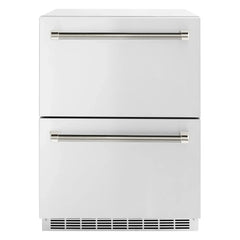
Refrigerator drawers install under the counter near prep areas, grills or wet bars, so produce, drinks or snacks live exactly where you use them. They work well in kitchen islands, and outdoor-rated versions suit outdoor kitchens.
Ice Makers
A standalone ice maker solves the problem of never having enough ice for entertaining, without relying on your main fridge. Our ice maker buying guide covers sizes, ice types and drain options.
Dry Agers
Dry-aging cabinets are a niche category for serious home cooks. They hold meat at a controlled low temperature with circulating air, so you can dry-age steaks and other cuts at home.
How Much Should You Spend on a Refrigerator?
Prices change often, so check current pricing on each product page. Here's what each tier typically gets you:
| Tier | What you typically get |
|---|---|
| Entry level | Freestanding top- or bottom-freezer models, standard depth, basic controls |
| Mid-range | French door or side-by-side, counter-depth options, ice maker or water and ice dispenser |
| Premium | Larger or pro-style models, dual cooling, designer finishes and trim, some built-in options |
| Built-in and luxury | Built-in, panel-ready and column refrigeration designed around custom cabinetry |
Your total budget should also cover installation, any water-line work and haul-away of your old unit. For built-in or column refrigerators, cabinetry, custom panels and professional installation can add significantly to the total.
Should You Buy Your Refrigerator as Part of an Appliance Package?
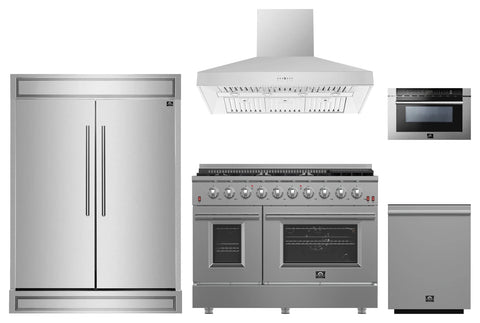
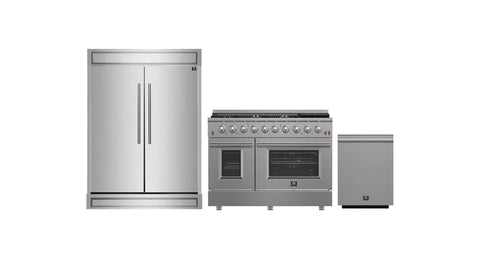
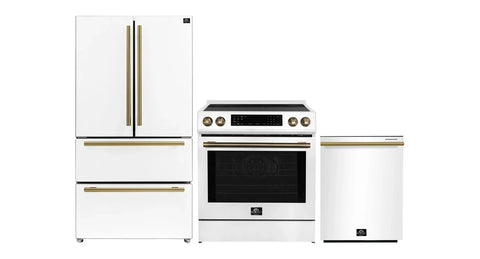
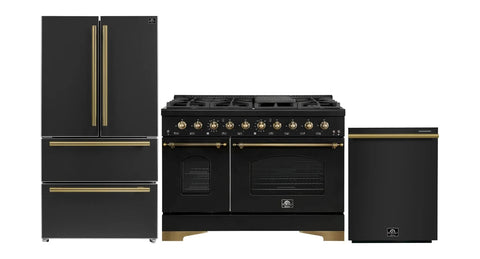
If you're replacing more than one appliance, a matched package is worth a look. Packages typically bundle a refrigerator with a range, dishwasher, and microwave or range hood from the same brand and finish line. You get consistent styling, and our packages are priced below buying the same pieces separately.
Refrigerator Brands at Home Outlet Direct
Here's what the main brands offer in our catalog today.
ZLINE
ZLINE has more refrigerator listings in our store than any other brand. The lineup includes 36-inch counter-depth and standard-depth French door models, built-in bottom-freezer and French door refrigerators from 30 to 72 inches, and column refrigerators and freezers. Finishes include stainless steel, fingerprint-resistant Satin Stainless Steel (formerly DuraSnow®), black stainless, white matte and panel-ready, and Autograph Edition models add polished gold, champagne bronze or matte black accents. For a model-by-model rundown, see does ZLINE make a refrigerator? or shop ZLINE refrigerators.
Forno
Forno is the one brand in our lineup that offers French door, side-by-side and bottom-freezer refrigerators as well as built-in convertible columns. That includes 30- and 36-inch French door models, 33- and 36-inch side-by-sides, compact and full-size bottom-freezer models, panel-ready Rivestito built-ins and Maderno convertible columns. The Forno Espresso collection pairs black or white finishes with antique brass or stainless steel trim. Shop Forno refrigerators or browse Forno Espresso refrigerators.
Thor Kitchen
Thor Kitchen offers freestanding French door refrigerators in standard and counter depth, including models with ice and water dispensers. Its X-Series adds built-in and panel-ready bottom-freezer refrigerators and column refrigerators and freezers, sold individually or as 42- to 54-inch pairs. The Gordon Ramsay by Thor Kitchen collection includes 30- and 36-inch counter-depth French door refrigerators in stainless steel, matte black or white, with contrasting trim options. Shop Thor Kitchen refrigerators.
Perlick
Milwaukee-based Perlick is a family business with more than 100 years in refrigeration. Its lineup with us centers on undercounter refrigeration (beverage centers, wine coolers, refrigerator and freezer drawers, ice makers), much of it in outdoor-rated versions, plus 24-inch built-in upright refrigerator and freezer models. It's worth a look if you're focused on the built-in and beverage end of the spectrum.
Other Brands at Home Outlet Direct
ILVE, Induction Hardware, Kucht, Cosmo, Verona, Vezeni and Kostch round out our refrigerator catalog. ILVE and Induction Hardware focus on built-in and column refrigeration, Kucht offers both built-in panel-ready and freestanding French door models, and Cosmo, Verona, Vezeni and Kostch offer freestanding French door options.
When comparing brands, look at warranty terms (they vary by brand and product type, so check the manufacturer's warranty page), matching appliance packages, and whether the brand offers the configuration and installation style you've settled on. Availability shifts throughout the year.
Common Refrigerator Buying Mistakes to Avoid
Measuring Only the Opening Width
Width is only part of the equation. You also need door swing clearance, floor-to-ceiling height, and a clear path from the delivery truck to the final spot, including hallways, doorways and tight turns.
Choosing Configuration and Installation Style Separately
Not every configuration comes in every installation style. Column refrigerators, for example, are built-in only. Confirm your preferred configuration is offered in the installation style you want before you fall in love with a specific model.
Underestimating Capacity Needs
It's common to size a refrigerator for today's household rather than where it's headed. If your family is growing, or you plan to entertain or cook more, buying at the low end of your range can leave you frustrated within a year or two. When in doubt, size up.
Ignoring Ventilation Requirements
Every refrigerator needs airflow, and built-in and column units are especially sensitive because cabinetry surrounds them. Skipping the manufacturer's specified clearances can make the compressor work harder, raising energy use and shortening its life. Confirm ventilation clearances before you finalize your cabinet plans.
Paying for Features You Won't Use
Headline features like interior cameras are easy to get excited about, while everyday helpers like convertible zones or a better ice setup get overlooked. Prioritize the features that match how you actually shop and cook.
Why Buy Your Refrigerator from Home Outlet Direct?
Home Outlet Direct is an authorized dealer for the refrigerator brands we sell, so your refrigerator ships new with the manufacturer's warranty. Our lineup runs from freestanding French door and side-by-side models to built-in, panel-ready and column refrigeration, plus wine coolers, beverage centers, refrigerator drawers, ice makers and dry-aging cabinets.
- Free shipping to the contiguous 48 states. We don't ship to Alaska, Hawaii, Puerto Rico, other U.S. territories or PO boxes. See our shipping policy.
- Freight delivery: refrigerators ship by freight with curbside drop-off. The carrier calls to schedule a delivery appointment, and an adult must be there to sign, so plan for help moving the unit inside.
- Financing is available at checkout. See our financing options.
- Extended protection: add a CPS extended protection plan at checkout for coverage beyond the manufacturer's warranty.
Final Checklist Before You Buy
- Measure your space, including door swing and the delivery path.
- Decide on a configuration: French door, side-by-side, top or bottom freezer, or column.
- Decide on an installation style: freestanding, counter-depth, built-in or panel-ready.
- Estimate capacity using the 4 to 6 cu. ft. per household member rule of thumb, then adjust for how you cook and shop.
- Set a total budget that includes installation and old-unit removal.
- List your must-have features (convertible zones, dispensers, ENERGY STAR, smart connectivity).
- Consider specialty refrigeration for wine, beverages, ice or dry aging.
- Check whether a matched appliance package makes sense for your renovation.
FAQs About Buying a Refrigerator
What is the most reliable type of refrigerator?
Reliability depends more on the specific brand and model than on configuration. That said, simpler designs, such as top- and bottom-freezer models without a through-the-door dispenser, have fewer components that can fail, which can mean fewer and simpler repairs.
Is counter-depth worth the extra cost?
If a flush, built-in look matters to you and you don't need maximum interior capacity, counter-depth is a worthwhile upgrade over standard depth. If capacity is your priority, a standard-depth freestanding unit will usually give you more usable space for the money.
Can I install a built-in refrigerator myself?
Built-in and column refrigerators need a precise cabinet opening, the ventilation clearances in the installation guide, and the correct electrical and water connections. Professional installation is strongly recommended.
How long do refrigerators typically last?
It depends on the model, how hard it works and how well it's maintained. ENERGY STAR uses a 12-year product lifetime in its savings estimates, and many refrigerators run longer with good care.
Do I need a dedicated wine cooler if my refrigerator has a wine rack?
A wine rack inside a standard refrigerator holds bottles at food-storage temperature, which is colder than typical wine storage, and the door opens many times a day. If you store wine long-term or own bottles meant for aging, a dedicated wine cooler is the better choice.
What's the difference between a French door and a side-by-side refrigerator?
French door refrigerators put the freezer on the bottom and split the fridge into two doors up top, giving you wider shelves. Side-by-side units split the fridge and freezer vertically into two full-height sections, so the doors are narrower and need less swing room, but the shelves are narrower too.
Ready to find the right fit for your kitchen? Filter our refrigerator collection by brand, refrigerator type, size, finish and depth to find your match.
Comments
0 comments