




















































Updated October 2026
Yes, Goodman is a good air conditioner brand for most homes. Goodman has made central air conditioners and heat pumps since 1982, has been part of Daikin Industries since 2012, and backs its equipment with a 10-year parts limited warranty when you register it. You won't get the very highest efficiency ratings or every premium feature, but you get solid, straightforward equipment at a value-tier price.
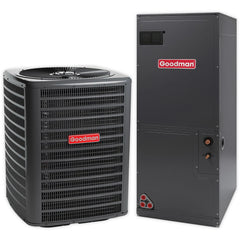
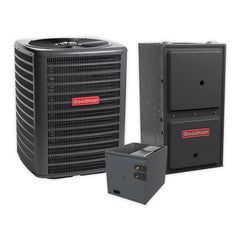
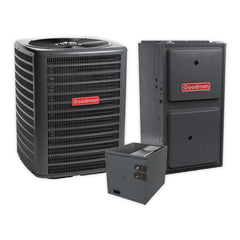
Goodman is positioned below Trane, Carrier and Lennox on price, which raises a fair question: are you giving up quality to save money? Below, we look at who makes Goodman, its SEER2 ratings, its warranty terms and how it compares. Already sure? Shop Goodman central split systems.
Who Makes Goodman Air Conditioners?
Goodman was founded by Harold V. Goodman in Houston, Texas, and entered the market as a maker of central air conditioners and heat pumps in 1982. In 2012 Goodman was purchased by Daikin Industries, Ltd., the Japan-based air conditioning company, and it now operates within Daikin Comfort Technologies North America.
Goodman equipment is assembled at the Daikin Texas Technology Park in Waller, Texas, just outside Houston, a 4.2-million-square-foot campus that Goodman calls the largest HVAC building in the U.S. So Goodman isn't a no-name budget label; it's the value brand of a large global HVAC company.

Is Goodman a Good Brand? The Short Answer
For most homes, yes. Goodman's R-32 lineup runs from single-stage systems at the federal minimum to inverter systems rated up to 19 SEER2 on our site, with a 10-year parts limited warranty when registered. It doesn't match the flagship Trane, Carrier or Lennox models on peak efficiency, but its tiers cover a wide range of budgets and climates.
Goodman AC Reviews: Performance and Reliability
Goodman has long carried a "budget brand" reputation, but a lower price isn't the same as lower quality. How long will a Goodman AC last? Manufacturers don't publish brand-level failure data, so the best guide is national data: a Lawrence Berkeley National Laboratory study based on national housing surveys estimated a median lifetime of about 18 years for central air conditioners and about 15 years for heat pumps.
What decides how long your system lasts is mostly installation and upkeep: correct sizing, a properly matched indoor unit, the right refrigerant charge and regular maintenance. The U.S. Department of Energy's Energy Saver guide recommends cleaning or replacing AC filters once a month or as the manufacturer recommends.
Goodman's single- and two-stage condensers are conventional designs that independent HVAC dealers install and service. Where Goodman shows its value positioning is at the top end: its most efficient air conditioner, the inverter-driven GXV9S, is rated up to 19 SEER2, while the flagship models from Trane, Carrier and Lennox are rated higher. The upper tiers aren't bare-bones, though. The GLXT7C has Goodman's ComfortBridge communicating technology, and the GXV9S has a quiet mode Goodman rates as low as 45 dBA.

Goodman Air Conditioner Reviews: SEER2 Ratings and Efficiency
Goodman systems on our site range from 13.4 to 19 SEER2. The exact rating depends on the outdoor unit and the indoor coil, air handler or furnace it's matched with. Here's how the Goodman model families we carry line up, using Goodman's published "up to" ratings:
| Tier | Air conditioners | Heat pumps |
|---|---|---|
| Single-stage (entry and mid) | GLXS3B (up to 15 SEER2), GLXS4B and GLXS4M (up to 15.2), GLXS5B (up to 16.5) | GLZS4B and GLZS4M (up to 15.2), GLZS5B (up to 16) |
| Two-stage | GLXT7C (up to 17.2) | GLZT7C (up to 17.5) |
| Variable-speed inverter | GXV6S (up to 17.2), GXV9S (up to 19) | GZV6S and GZV7S (up to 19) |
For reference, Goodman's own lineup tops out at 19 SEER2 for air conditioners (GXV9S) and 21 SEER2 for heat pumps (GZV9S). We also carry Goodman packaged units, which put the whole system in one outdoor cabinet and are listed at 13.4 to 15.2 SEER2 on our site.

Which Goodman tier fits your home?
Federal minimums set the floor: 13.4 SEER2 for split air conditioners in the North, 14.3 SEER2 in the Southeast and Southwest (plus an EER2 requirement in the Southwest), and 14.3 SEER2 and 7.5 HSPF2 for split heat pumps nationwide. A 13.4 SEER2 system suits a Northern home with a short cooling season. In hot climates, meet your region's minimum and consider a two-stage or inverter model if your AC runs most of the year. Our SEER vs. SEER2 guide explains the ratings.
For any brand, the number that counts is the certified SEER2 for your exact outdoor-and-indoor combination, listed under its AHRI reference number. Brochures quote the best-case "up to" figure.
Refrigerant: Goodman uses R-32
Goodman's current air conditioners and heat pumps use R-32, a refrigerant whose global warming potential is below the 700 limit the EPA sets for new residential AC and heat pump systems. R-32 isn't proprietary to Goodman or Daikin. Carrier, Trane and Lennox chose R-454B for their whole-home ducted systems instead. Both are mildly flammable (A2L) refrigerants, so equipment must be designed for them, and neither can go into an older R-410A system. Our R-454B vs. R-410A guide explains the transition.
Goodman Warranty Coverage
Goodman's warranty is a strong selling point, but the full term depends on registration, the model and the installation. Here's what Goodman's warranty guide and spec sheets list.
- 5 years without registration. Goodman equipment comes with a 5-year parts limited warranty.
- 10 years when registered. Register online within 60 days of installation and the parts limited warranty extends to 10 years. Residents of California, Florida, Georgia and Quebec get registered-owner coverage without registering.
- Unit replacement on higher tiers. The two-stage GLXT7C and GLZT7C and the inverter GXV6S, GXV9S, GZV6S and GZV7S add a 10-year unit replacement limited warranty for registered owners. Goodman also offers one-time compressor replacement coverage for years 11 to 99 through a separate ASURE Extended Service Plan.
- Gas furnaces. Heat exchanger coverage runs from 20 years to lifetime, depending on the model.

Before you buy: installation and ownership rules
- Plan on a licensed HVAC contractor. Goodman's internet purchase policy says it offers no warranty coverage on Goodman equipment bought online unless a dealer installs it in line with all applicable federal, state and local codes and licensing requirements. Hire a licensed contractor, keep the installation paperwork, and register within 60 days.
- Coverage follows the original owner. Registered coverage lasts as long as the original registered owner or their spouse owns and lives in the home. Some states require coverage to transfer when the home is sold; Goodman's warranty information page lists Florida, Georgia and Texas, for units installed after specific dates.
- Read your model's certificate. Terms, limitations and exclusions vary by model.
Decided Goodman is right for your home? Shop Goodman central split systems.
Goodman vs. Trane, Carrier and Lennox
Value is Goodman's main advantage in these matchups. Here's the short version; for a full side-by-side, read our Goodman vs. Trane vs. Carrier comparison.
Goodman vs. Trane
Trane is typically positioned as a premium brand. Trane says its air conditioners range from 13.4 SEER2 up to 23.6 SEER2 for its most efficient model, above Goodman's 19 SEER2 ceiling. When weighing the two, compare matched systems at the same SEER2 level.
Goodman vs. Carrier
Carrier lists air conditioners with SEER2 ratings as high as 21, with its Infinity line at the top. At the entry and mid tiers the efficiency gap narrows, because every brand's basic systems are built to the same federal minimums.
Goodman vs. Lennox
Lennox's top air conditioner, the SL25KCV, is rated up to 26.0 SEER2, the highest of these four brands. If maximum efficiency is your priority, that's a real difference. If value at the entry and mid tiers matters more, Goodman is the more practical choice.
To sum up, premium brands win on peak efficiency and top-tier features. Goodman wins on value, especially in the entry and mid tiers. Comparing other value-focused options? MRCOOL and Senville also offer ducted systems on our site: see MRCOOL central split systems and Senville central split systems.
Pros and Cons of Goodman AC Units
Pros
- Part of Daikin since 2012 and assembled at the Daikin Texas Technology Park near Houston
- Value pricing compared with premium brands
- A full range of tiers, from 13.4 SEER2 single-stage systems to 19 SEER2 inverter systems on our site
- 10-year parts limited warranty when registered, plus 10-year unit replacement on two-stage and inverter models
- Uses R-32, a lower-GWP refrigerant that meets the EPA limit for new systems
Cons
- Top air conditioner efficiency (19 SEER2) trails the flagship models from Trane, Carrier and Lennox
- The old "budget brand" reputation can be a hard sell
- Warranty depends on licensed installation, and the 10-year term requires registration in most states
- Registered coverage stays with the original owner unless your state requires a transfer
Is Goodman Worth It in 2026?
For most homeowners, yes. Goodman isn't trying to be the flashiest name in HVAC; it's the value brand of a company (Daikin) that also builds premium systems. If your priority is dependable cooling, solid efficiency and a lower upfront cost, Goodman is a genuinely good brand, not just a cheap one. If you want the highest efficiency available or the quietest possible system, look at Daikin's own lineup or the flagship models from Trane, Carrier and Lennox.
Not sure whether you need an AC or a heat pump? Start with our heat pump vs. AC guide and our HVAC buying guide. When you're ready, browse all Goodman products, including heat pump split systems and AC and gas furnace systems. HVAC equipment ships free by freight to the contiguous 48 states (curbside, by appointment), and financing is available at checkout.

Comments
0 comments