




















































Updated October 2026
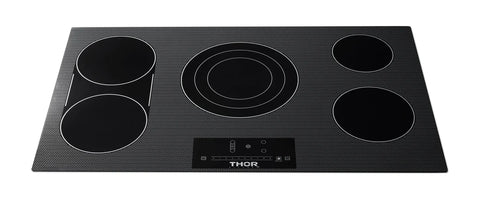
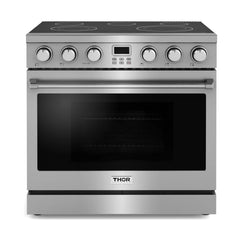
An induction range heats the pan itself rather than heating a burner or the glass. Copper coils under the cooktop create a magnetic field, and that field generates heat directly inside magnetic cookware such as cast iron or magnetic stainless steel. The result is fast, precise heat with a cooktop surface that stays cooler than gas or standard electric.
Induction isn't a passing trend. It's one of the most efficient ways to cook at home, and home cooks and serious chefs alike like it for its control. Many shoppers still aren't sure how it works, what cookware it needs, or what it takes to install. This guide covers all of it, from the science to the wiring.
How does an induction range work?
Induction cooking is built on electromagnetic induction, the principle discovered by scientist Michael Faraday: a changing magnetic field can create an electric current in a nearby conductor. Here's how that plays out on your cooktop:
- Under each cooking zone sits a tightly wound copper coil.
- When you turn the zone on, alternating current flows through the coil and creates a rapidly changing magnetic field.
- When you set a pan made of magnetic (ferromagnetic) metal on the zone, that field induces electric currents inside the base of the pan.
- The pan's resistance to those currents turns them into heat, and the pan heats your food.
As ENERGY STAR puts it, with induction "the source of heat is the cookware itself." The glass surface only gets warm from contact with the hot pan.
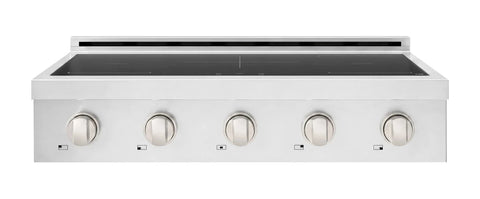
An induction range combines this induction cooktop with an electric oven underneath, often with convection. If you only want the cooktop, for an island for example, look at induction cooktops instead.
Induction vs. gas vs. standard electric
| Induction | Standard electric (radiant) | Gas | |
|---|---|---|---|
| How heat is made | Magnetic field heats the pan directly | Element heats the glass, glass heats the pan | Open flame heats the pan |
| Energy delivered to the food* | About 85% | About 75–80% | About 32% |
| Response to adjustments | Nearly instant | Slower; element holds heat | Instant |
| Cooktop surface | Warm only where the pan sat | Hot | Hot grates |
| Cookware | Magnetic only | Any flat-bottomed pan | Any |
*Approximate energy transfer efficiency as published by ENERGY STAR, which also notes induction is about 5–10% more efficient than conventional electric resistance cooktops.
Cookware compatibility: the magnet test
Because induction depends on magnetism, your pans need a magnetic base. The easiest check is to hold a fridge magnet to the bottom of the pan. If it sticks firmly, the pan will work.
- Works well: cast iron, enameled cast iron, carbon steel, and most magnetic stainless steel. Many pans are labeled "induction-ready."
- Won't work on its own: aluminum, copper, glass and ceramic, unless the pan has a magnetic layer bonded to the base.
- Check your stainless: some stainless steel is not magnetic, so test each pan rather than assuming.
You don't need expensive specialty cookware. Plenty of everyday pans pass the magnet test. Flat bottoms make the best contact, and very small pans may not be detected by a large zone, so check your range manual for minimum pan sizes.
The benefits of cooking with induction
- Speed. ENERGY STAR notes that induction cookware reaches the desired temperature more quickly and cooks faster. Water comes to a boil fast, and the high-power settings make quick work of searing.
- Precise control. Heat changes almost the instant you adjust the setting, which makes delicate tasks such as melting chocolate, holding a sauce or simmering rice much easier.
- Efficiency. Because the heat is made in the pan, less is lost to the room. A cooler kitchen in summer is a bonus.
- No open flame. There's no flame and no gas burning in your kitchen.
- Easier cleanup. The glass doesn't get as hot as a radiant element, so spills are less likely to bake on and usually wipe right up.
The drawbacks to consider
- Cookware. You may need to replace aluminum, copper or non-magnetic stainless pans.
- Electrical work. If you're replacing a gas range, you'll likely need a new 240-volt circuit (see below).
- Upfront cost. Induction ranges typically cost more than basic radiant electric models. Check current pricing in our induction range collection.
- Sound. Some pans make a faint hum or buzz on high settings, and cooling fans run while you cook. Both are normal.
- Glass care. The ceramic glass top can scratch if you slide heavy cast iron across it. Lift pans instead of dragging them.
- Power outages. Like any electric range, an induction range won't work without power.
Electrical requirements for an induction range
Full-size induction ranges run on a dedicated 240-volt circuit, and the required amperage depends on the model. For example, ZLINE lists its 30-inch Paramount induction range (SINR30) at 240V and 50A. Always confirm the breaker size, wiring and receptacle in the installation manual for your exact model.
If you're switching from gas, have a licensed electrician check that your electrical panel has capacity for the new circuit, and have a qualified professional cap the old gas line. Book this work early in your project. It's one of the most common things that delays an induction upgrade.
Safety features
ENERGY STAR notes that a cooler cooktop surface makes induction safer to work with than other cooktop types. Many induction ranges also include:
- Pan detection. A zone won't heat without compatible cookware on it.
- Residual heat indicators. These warn you when the glass is still warm from a hot pan.
- Automatic shut-off and control locks. Handy in homes with children.
The surface isn't cold. A hot pan warms the glass beneath it, so treat a recently used zone with care. If anyone in your household has an implanted medical device such as a pacemaker, read the safety section of the range's manual and talk with your doctor before switching.
Cleaning and care
Wipe the glass with a soft, damp cloth once it has cooled, and use a cooktop cleaner made for ceramic glass to remove film and prevent scratches. Avoid abrasive pads. Keep pan bottoms clean, because grit trapped under a pan is what usually scratches the surface.
Do you still need a range hood with induction?
Yes. Induction removes the combustion byproducts of gas, but cooking still produces smoke, grease and steam. Size the hood at about 10 CFM per inch of cooktop width, so roughly 300 CFM for a 30-inch range and 360 CFM for a 36-inch range. Our guide to range hood CFM ratings walks through it, and you can browse matching range hoods.
Induction ranges at Home Outlet Direct
We carry induction ranges from several brands, from compact widths to 48-inch pro-style models. All ship new in the box with the manufacturer's warranty.

- Forno induction ranges: includes the Torino, Donatello and Leonardo series, plus Espresso designer finishes. Forno ranges carry a 2-year manufacturer warranty.
- ZLINE induction ranges: the Paramount induction line, including Autograph Edition designer accents.
- Thor Kitchen induction ranges: includes professional-style models from Thor Kitchen and Gordon Ramsay by Thor Kitchen.
- ILVE ranges: Italian ranges with induction versions in the Nostalgie II, Professional Plus II, Panoramagic and Majestic series. See our ILVE series comparison.
- 48-inch induction ranges: for large kitchens that want more cooking zones and a bigger oven capacity.
Still deciding between fuel types? How to Choose the Perfect Stove compares gas, electric and induction side by side.
Is an induction range worth it?
If you want fast, precise heat, a cooler and safer cooktop, and the most efficient way to cook on electricity, induction is worth a close look. Plan for magnetic cookware and a 240-volt circuit, and you'll have a range that's quick to heat, easy to clean and enjoyable to cook on. Questions about a specific model or your wiring? Our team can help you compare options.

Comments
0 comments